
Nutcracker Sampler: the Stahlbaum house on Christmas Eve...

Updated: Jun 29
'Christmas in July' is nearly here, so I'm looking forward to introducing you to a new cast of Petit FOUR sampler patterns, perfect for the festive season: the Nutcracker blocks.
Tchaikovsky's enchanting ballet was inspired by ETA Hoffman's fantastical Christmas tale of The Nutcracker and the Mouse King and, a century later, a family outing to see the Nutcracker became a cherished Christmas tradition for children and adults alike.
For the past nine months Andrea from the Willow Cottage Quilt Company and I have been keeping the spirit of Christmas alive as we posted parcels of Tilda-filled goodness to our Nutcracker Block of the Month participants, transporting them through a fairytale forest to the land of sweets.

In my first post I'll be introducing you to our leading lady, Clara, and the intriguing Nutcracker doll she received on Christmas Eve...
Christmas Tree
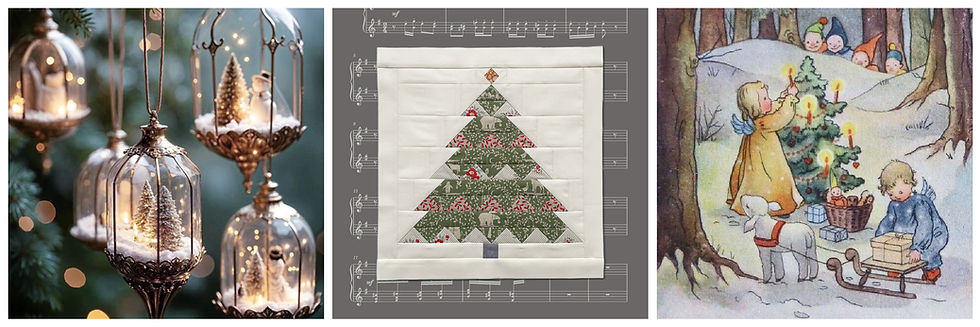
As the orchestra strikes up and the curtains open we meet the Stahlbaum family - Dr. and Mrs. Stahlbaum and their children, Fritz and Clara - getting ready for a Christmas Eve party by lighting the candles on their magnificent Christmas tree.
We've bedecked our homes with evergreens to celebrate winter festivals since ancient times, but it was Hanseatic merchants in 16th century Riga who first decorated a whole tree. The custom spread throughout Germany over the following centuries and was taken to North America by German settlers and made fashionable in Europe by German princesses who married into its Royal Houses. While German Prince Albert is credited with introducing the Christmas Tree to Great Britain, it was actually Queen Victoria's German grandmother, Charlotte, fifty years earlier.
Traditionally, Christmas trees were decorated with apples, gilded nuts and glace fruits - the original sugar plums - until, in 1847, in the Thuringian Forest town of Lauscha, craftsman Hans Greiner created the first blown-glass decorations to mimic them. They were hand blown into moulds, and then silvered inside with a concoction of silver nitrate and sugar water. Lauscha still holds its famous Kugelmarket (bauble market) every November.
A PDF Pattern for the Christmas Tree block is available here.
Clara

I'm delighted to introduce you to the Stahlbaum's daughter, Clara, our leading lady.
But first I have to impart some rather shocking news: Hoffman and, indeed, Alexander Dumas who translated his story into French, didn’t call her Clara. They named her Marie – Miss Clara was her favourite doll - but in Tchaikovsky’s ballet she becomes Clara. Hoffman had written about a character called Clara in another story and that too was turned into a ballet: Coppélia.
Curious, kind and brave, Clara inspires the Nutcracker to do battle with the Mouse King at the end of Act I, saving his life with a well-aimed slipper and breaking the curse that had transformed him from a prince into a wooden nutcracker. As our story begins at the stroke of midnight, we're left wondering whether she dreamed the whole thing. But she’s a splendid heroine and I wonder how many little girls have been called Clara in her honour.
There's a wonderful scene, earlier in Act I, when the tree ‘grows’ while Clara seemingly shrinks in size to dance with the toys. Something Tchaikovsky must surely have borrowed from another splendid heroine, Lewis Carrol’s Alice.
A PDF Pattern for the Clara block is available here.
Nutcracker

And now it’s time to meet our main character, the Nutcracker. Once our dear heroine, Clara, is gifted this curious little wooden figure by her godfather, Drosselmeyer the toymaker, the scene is set for adventure.
You may be wondering, why a Nutcracker? Well, nuts have had an enduring association with Christmas for centuries: whether they’re tucked into Christmas stockings; gilded and strung across the branches of a Christmas tree; chopped up in chestnut stuffing and rich fruit cakes; or ground down to make marzipan. And you can’t shell a nut without a nutcracker.
The carving of decorative wooden figures – including nutcrackers - developed in the isolated forest communities of C17th Europe as a cottage industry, particularly in Saxony’s Ore Mountains, which run along its border with Czech Bohemia. The familiar figure of the little soldier who cracks a nut with his magnificent teeth was developed a century later and became so popular it hasn’t really changed since. To this day family workshops spend the year hand carving and turning wooden toys in readiness for the Christmas Markets.
A PDF Pattern for the Nutcracker block is available here.
I'll be releasing a PDF book with all of the Nutcracker PDF block patterns collected together, along with their Land of Sweets setting, on the 6th of July. And if you'd prefer a printed Pattern book, they'll be arriving in the shop - and Amazon - in a couple of weeks.
In my next Nutcracker post we'll be exploring the characters who appear in the exciting finale to Act I: the battle between the mice and the toys. You'll be on the edge of your seats...
with love from the studio,


