WELCOME! Andrea - from the Willow Cottage Quilt Company - and I are delighted that you can join us to create a quilt that will take you on a wonderful, whistle-stop tour of the British capital…
Over the next nine months we will be 'visiting' all the major sights - Westminster Abbey, the Tower of London, Buckingham Palace, Parliament Square, Greenwich and the Southbank - not forgetting a stroll through London's lovely parks and a pitstop at Liberty's on Regent Street.
Your parcels of goodies will be posted on the second Tuesday of each month and, if you've joined us before, you'll know that there will be some fun extras and a bonus project or two along the way.
I like to think of this page as our group journal where I'll share my inspiration for each block, some hidden histories and extra tutorials to help you on your journey, so be sure to check in every month when you've received your parcel, just scroll down to see each mont's post. You can also join our private Facebook group so that you can come and chat with us - and each other - there too.
Andrea and I both encourage you to share your progress on Instagram and Facebook with the #londontownbom hashtag, we love seeing your posts!
Month 1: November, Westminster Abbey
Month 2: December, Tower of London
Month 3: January, Royal Parks
Month 4: February, Buckingham Palace
Month 5: March, Parliament Square
Month 6: April, Cutty Sark
Month 7: May, Libertys of London
Month 8: June, London Transport
Month 9: July, London Eye & Assembly


London Town Block of the Month
London Town: month 1

Welcome to month one of London Town, Westminster Abbey.
All aboard the tour bus: our sightseeing excursion around London Town is about to begin and this month we’re exploring Westminster Abbey.
Most recently the venue for our beloved Queen’s funeral, Westminster Abbey has been at the heart of national life for a thousand years. It's hosted every coronation since William The Conqueror’s in 1066, along with many a royal wedding and service of remembrance and is also the final resting place of seventeen monarchs and thirteen royal consorts.
Founded by Edward the Confessor in 1065, it became known as the west minster to distinguish it from St Paul's Cathedral - the east minster - in the City. Unfortunately, when his new church was consecrated on 28th December 1065, Edward was too ill to attend. He died a few days later and was buried in front of the High Altar.
His 13th century successor, Henry III, was particularly devoted to Edward - adopting him as his patron saint - and demonstrated his devotion by… demolishing the Abbey. He rebuilt it in the splendidly fashionable Gothic style, giving it the highest nave in England. Traces of Edward's abbey can still be seen in the round arches and massive supporting columns of the under croft and Pyx Chamber, but the only depiction left is, ironically, in the Bayeux Tapestry.
Two centuries later King Henry VII added the Lady Chapel, with its gravity-defying, fan-vaulted ceiling. But then his son Henry VIII closed all of the monasteries, so Westminster Abbey has not, in fact, been an abbey since 1539. Henry granted it cathedral status - sparing it from destruction - and his daughter Elizabeth I made it a royal peculiar: a church responsible directly to the monarch, which it has been ever since.
Buried alongside the great and the good in the Abbey is a humble Shropshire farm labourer called Thomas Parr, who won Royal patronage by claiming to be 152 years and 9 months old. Invited to London to meet King Charles I, Thomas left Shropshire never to return: rich food and a lack of good clean, country air caused his demise within weeks of arriving and the King decreed that he be buried in the Abbey.
Our quilt block shows the Abbey’s magnificent West Entrance. Its flanking towers were left unfinished in the medieval period - with one slightly taller than the other - and they weren't actually completed until 1745. Just inside the West Door is the Abbey’s most poignant memorial, the grave of the Unknown Warrior, buried on Armistice Day 1920 to represent all of the men and women who never returned home from the First World War.
The fine gothic stonework on our Westminster Abbey block is fashioned in Tilda Hometown’s Neighbourhood, Berrytangle and Applegarden prints. Remember to hang on to your scraps for later blocks and take a look at the techniques box, right, for my hints on snowballed corners.
This month's parcel includes the London Town Pattern Book – with a smart, spiral binding so you can lay it flat as you sew – plus two notions to set aside for future months: a bias tape maker and some fray check.
We’ll be using the latter next month, but until then, happy sewing :-)
This month's technique...

Snowballing the corner of a piece of fabric - by adding a 45º triangle of another fabric - gives the illusion of a rounded corner, or in this case, a gothic window frame.
It's one of my favourite techniques and I think I've tried every trick in the book to make my snowballed corners accurate.
Here are my favourite tips:
a: If you are sewing with a directional print - like Neighbourhood - 'test' your square in place first, to make sure it's the right way up, before marking the diagonal line;
b: When sewing small pieces always pin. It seems like an unnecessary step, but it's so much quicker than unpicking a wonky seam (ask me how I know...);
c: Use a sharp pencil - or fine marker - to mark the diagonal line, place it exactly in the corner and sew directly ON the line. What will really improve your accuracy is using a lovely, fine thread (I love Aurifil 50 weight);
d: Press your top square first, to check that you're completely happy, before trimming away the back layers of fabric. Again, it might seem quicker to trim first then press, but once those back layers are gone, they're gone!
Just a quick note to let you know that an error has been noticed in step 6 of the Westminster Abbey directions - my thanks to Diane for bringing it to my attention - and it should read: …snowball both top corners of a 2½” aqua square with 1½” gold squares…
London Town: month 2

Welcome to month two of London Town, the Tower of London.
Brace yourself, because this month I'm sending you to the Tower! In days of yore that would have been very bad news indeed, because the Tower of London has spent half of its 900-year history serving as a the most fearsome prison in the land.
It was founded by William the Conqueror in 1067 and strategically sited on the river Thames next to the old city walls, dominating London as a symbol of Royal power. His 13th century successors - and enthusiastic builders - Henry III and his son, Edward I, created the Tower complex we see today, enlarging the moat and adding the outer defensive walls along with a new water gate onto the river, which later became known as Traitor's Gate.
Henry is credited with establishing a Royal menagerie at the Tower after being gifted three leopards. They were swiftly joined by a polar bear and an African elephant (the polar bear was apparently allowed to fish in the river). But by the 19th century there were 150 animals squeezed into the Tower precinct, so they were built more suitable lodgings at the newly created Regents Park.
More prosaically, Edward installed the Royal Mint within the safely of its walls, where it stayed nearly as long, and the Tower also acted as the safe repository for documents, armaments, the crown jewels - which are still there - and, most famously of all, Royal prisoners. The 'Princes in the Tower', the two teenage sons of Edward IV, were sent there for their 'protection' by Richard II in 1483 and were never seen again. And Henry VIII's unlucky wives, Anne Boleyn and Catherine Howard, were both imprisoned and executed within its walls.
One happy legacy of those days are the Yeoman Warders, resplendent in their tudor uniform, who were part of the monarch's personal bodyguard and allowed to eat as much beef as they pleased from the Royal table, hence their nickname: the Beefeaters.
They and their families still live within the Tower - they even have a pub! - along with the its most eccentric residents, the Ravens. When the Tower briefly served as the Royal Observatory in the late 17th century, the royal astronomer complained to Charles II that the birds were a nuisance, but was informed of the old legend that if the ravens left, the Tower would fall and a great disaster befall the Kingdom. Charles wisely moved the observatory to Greenwich.
Hopefully, creating your Tower of London block will be disaster-free, but please read my notes for this block in the Technique Box.
This month's technique...

This month we will use the ribbon in your parcel to add the pennants to the turrets on each side of our Tower.
Use the fray-check included in your Month One parcel to seal the cut edge of the ribbon. The other end is secured in a seam.
I glue basted my pennants in place - using my favourite Sewline glue pen - and found that lining up the edge of the ribbon with the inside edge of my presser foot kept my stitches lovely and even.
If the ribbon elements don't appeal, you could make your flags with raw-edge applique - using scraps of fabric fused in place - or with embroidery.
{The eagle-eyed amongst you will notice that this photo is from a later block (the Cutty Sark) as my Tower photos were a little out of focus}
London Town: month 3

Welcome to month three of London Town, the Royal Parks
This month we're going to step away from London's busy streets for a moment and go on an outing to the Park.
Until the 17th century, the city stayed within the 'square mile' of its Roman Walls, surrounded by the fields and villages which supplied its population with food. The first parks were actually deer parks, created by royal licence and reserved for the nobility to hunt in.
The deer park at Greenwich was inherited by Henry VI in 1447 and became the perfect place for the royal family to escape from the confines of the city. A century later, hunting-mad Henry VIII, was 'gifted' Bushy Park - along with Hampton Court Palace - by Cardinal Wolsey (under some duress) along with his Westminster residence. Keen to move out of the Tower with his new wife, Anne Boleyn, Henry purchased St. James's Park and enlarged it by confiscating Hyde Park from the monks of Westminster Abbey after the dissolution of the monasteries. As we know, Anne didn't get to enjoy her new parks for long and found herself back at the Tower!
Three-quarters of London was destroyed in the great fire of 1666 and the new city was rebuilt beyond its old walls. Looking enviously over the channel to the Palace Gardens at Versailles, Charles II remodelled St. James's Park, planting grand avenues of trees, opening it to the public and settling in a pair of pelicans gifted to him by the Russian ambassador. Their descendants live there to this day.
This was also the time when the crowded medieval streets were replaced by elegant garden squares, bringing much needed greenery to a city which would triple in size during the 1700s. The population tripled again during the nineteenth century, spreading ever outwards with the railway and underground networks. In 1811 George IV remodelled another of Henry's deer parks to create Regent's Park, creating a new home for the Royal Menagerie then housed at the Tower (pelicans excepted) and in 1842, Victoria Park was opened as the first of four new public parks, resplendent with bandstands and flower-lined paths, created for the enjoyment of all Londoners.
Although Greater London now covers 600 square miles rather than one, it has 3,000 parks of varying sizes which make up 100 square miles of green space. And in the quieter corners of Greenwich and Richmond parks you can still see deer...
This month we are going to be creating two mirror image blocks (one adorned with a little pelican). When you've made one, remember to turn it to the wrong side to act as a guide for the second. And please make a note of the pattern revision before you start sewing.
This month's treat...
This month your parcel includes the first of our exclusive treats, inspired by vintage travel badges: the perfect souvenir of our tour.

Revision to steps 5/6 and 16
Having gone to the trouble of mentioning the orientation of the background rectangle in the written directions for step 5, I have managed to draw it the wrong way around.
The side pieces in step 16 should be reversed (although it will still look cute)
I’m so sorry for any confusion and am very grateful to our lovely block-of-the-monther, Nancy, for spotting the errors. Please find a PDF of the revised directions here.
London Town: month 4

Welcome to month four of London Town, Buckingham Palace.
Time to get your poshest frock out of the wardrobe: we're off to the Palace!
Buckingham House was built in 1703 and only became a palace when it was purchased by George III as a private home for his large family later that century. His spendaholic son, George IV, made lavish alterations to the Palace, but George's brother, William IV - who succeeded him - wasn't keen and offered it to Parliament when the the Palace of Westminster was destroyed by fire. They declined.
It became a family home again when Queen Victoria acceded to the throne in 1837. She became the first monarch to make an appearance on the Palace's iconic balcony, along with Prince Albert, during celebrations for the opening of the Great Exhibition in 1851. The balcony is the focus of this month's block (because the entire façade would take over the quilt!).
The splendid, tree-lined Mall was added a hundred years ago when the Victoria Memorial was built and the East front - and that famous balcony - refurbished in classical style. Buckingham Palace is now the royal family's HQ and crowds gather in the Mall to celebrate every national event. They will gather there again this May for the coronation of King Charles III.
More than 50,000 guests are invited to the Palace each year, to state banquets, garden parties - the 42 acre gardens behind the palace are the largest in London - lunches and receptions, including Paddington Bear. Luckily his rather accident-prone visit during last year's Jubilee was captured on film.
I hope you'll treat yourself to a nice cup of tea (marmalade sandwich optional) when you open this month's parcel, which includes an extra half yard of background fabric, along with the Friendly Gathering print in blue and My Neighbourhood in rust, so that you can make the first pair of Union Jack filler blocks to go along with the Buckingham Palace block.
PS: If you ever visit the Palace, look out for the secret door in the White Drawing Room: at first glance it's an ornate console table, topped by a large mirror and gilded candlesticks, but those candlesticks are screwed down and the whole thing swings away from the wall to reveal a door to the private apartments. I do love a secret door...
This month's housekeeping...
Andrea has noted the following amendment to the Buckingham Palace pattern: you will need to cut 4 1" x 13" pieces from the pink fabric (not 2 as shown on the cutting diagram); also, please note that there is a line missing to the left of the pediment on the assembly diagram, which might be a tad confusing, be sure to follow step 14.
This month's tip...
I mentioned using directional fabric in month one and we'll be using directional prints again for the Union Jack blocks.
I used a small cutting board to lay out my blocks, so that I could keep all of my pieces in exactly the same order and carry it over to my machine to work on them.


London Town: month 5

Welcome to month five of London Town, Parliament Square.
This month - at the halfway point in our block of the month - we're stopping to check the time with, arguably, the world's most famous clock: Big Ben in Parliament Square.
The name Big Ben actually refers to the bell that strikes the hours, rather than the clock tower, which was renamed the Elizabeth Tower in 2012 to celebrate the late Queen's diamond jubilee. It's not the first clock tower at Westminster: a 14th century tower housed the first public chiming clock in England, but fell into disrepair and was replaced, rather bizarrely, by a sundial in 1707, leaving nearby St. Paul's cathedral to chime the hours.
The old Palace of Westminster - the seat of government for 800 years - was destroyed by fire in 1834. The new Palace, designed in the Gothic style of neighbouring Westminster Abbey, included a magnificent clock tower. The clock was constructed to the designs of amateur horologist Edmund Beckett Denison. Denison's wonderfully named ‘Double Three-Legged Gravity Escapement’ ensured the clock’s accuracy despite external factors like wind pressure on the hands, although the original cast-iron hands were too heavy and had to be replaced with copper ones. It began keeping time on the 31st May, 1859.
The first time the chimes of Big Ben were heard outside of Westminster was on the 31st of December 1923, when the BBC broadcast them to the nation to ring in the New Year. The midnight chimes of Big Ben are now a traditional part of New Year's Eve celebrations in London and on screens across the UK.
This month we are also making our smart Grenadier Guard block, using gold embroidery thread to embellish his uniform, which is included in your parcels along with navy thread for Big Ben's clock face.
This month's technique...
This month we are adding a touch of applique and simple embroidery to our Big Ben block to create its iconic clock face.
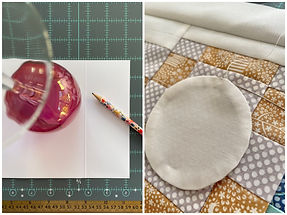
Tracing a circle can be quite challenging (and who can ever find a compass when they need one) so this month's tip is to raid your drinks cabinet for a suitably sized glass, using the template as a size guide: so much easier to draw around.
I've chosen to use needle-turn applique, but if you prefer fusible raw-edge applique then that would look marvellous too.
I've a bit of housekeeping to do this month. Firstly, North American friends, I gave you all - not least, Andrea - a fright by including the Union Jack background fabric in my parcels last month. Andrea is not able to send out that fabric until next month. Apologies for the confusion!
And while we're on the subject of Union Jacks, I'd like to draw your attention to a typo in the pattern: in step 3 (page 54) you are asked to cut 2” x WOF strips then subcut 1½” x 7½” pieces when, of course, they should be 2” x 7½” pieces. Thanks for spotting the error Lindsey (and sorry for the unpicking!!)
Lastly, for those of you who are new to placement templates, please do look at this blog post, which will be helpful when making Big Ben's roof (which is, essentially, a triangle-in-a-square block). And this blog post, which covers the basic principles of using placement templates and some extra trimming tips.
London Town: month 6

Welcome to month six of London Town, the Cutty Sark.
Are you ready for a bracing trip along the river to the Maritime Museum at Greenwich? This month we're exploring London's trading past from the deck of the Cutty Sark.
London was a port long before it became a great city. As islanders, the ancient Britons established strong trading routes, unfortunately attracting the attention of the Romans, who invaded - by sea - and founded the city. And as the focus of the Roman road system, London was established as England's commercial centre.
The history of ship building in the Port of London goes back to the time of Alfred the Great in the ninth century. Six hundred years later, Henry VIII opened Royal Dockyards at Deptford and Woolwich. In 1606, fourteen years before the Pilgrim Fathers set out from Plymouth, three small ships, the Susan Constant, Discovery and Godspeed sailed from London, financed by the London Company of Merchant Adventurers, and founded the state of Virginia.
In the 'Age of Sail' London's fortunes were tied to the trade winds: cargo ships could take up to two years to make a return journey, but faster ships could beat the competition, commanding higher prices, and no cargo was more prized than... tea. Fashionable Victorians paid a premium to drink the first of a new tea harvest, which lead to the ‘great tea races’. The Cutty Sark was built exclusively for this trade: on its maiden voyage the ship departed London on the 15th of February 1870 bound for Shanghai and, after only 25 days in port, sped back to London, arriving on the 13th of October, laden with 1,305,812 lbs of tea. Although I doubt it lasted long!
But the very same week the Cutty Sark set sail, the Suez Canal opened, ultimately forcing her out of the trade for which she'd been built. Steamships could now take advantage of this ‘short cut’ to bring larger cargoes home even more quickly, ending the Age of Sail.
And we're going to dabble with some 'new technology' ourselves, because this month's block uses the partial seam technique: sail over to the Techniques Box for my tips.
This month's technique...
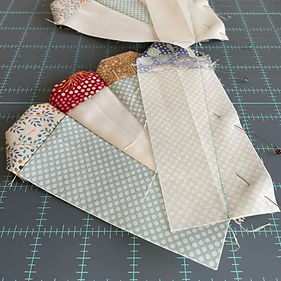
The partial seam in the Cutty Sark block allows us to add a flag to the top of the mast when the block is partially assembled.

To remind myself not to sew along the whole seam, I like to mark a line in the seam allowance with a water soluble pen, shown blue in my photo.
When closing the seam, always sew from the end of the previous stitches to avoid any pleats or puckers in the seam.
Andrea and I have had to make a slight alteration to the contents of this month's parcel and you will notice that the Elanora blue print has been substituted for the Elanora rust print shown in the pattern. In truth, they are very similar, hence the mix up. Apologies dear friend xx
First mate Diane noted a couple typos in our Facebook Page: In step one you should cut a 4½" x 5" piece from the background Fat Quarter, not 4" x 4½" as shown and in step 8 you should join a 1½" square of background to the 1½" square of grey, then add a 1" x 1½" piece of background to the bottom (or that would be a pretty top heavy crows nest). Thanks Diane!
London Town: month 7

Welcome to month seven of London Town, Liberty of London.
This month we are heading to one of my favourite 'sights', although it may not be in any of the guide books: Liberty of London, a beautiful shop full of beautiful things which stretches along Great Marlborough Street from Regent Street to Carnaby Street
The business was founded by Arthur Lasenby Liberty in 1875 with a loan of £2,00 from his father-in-law. Selling an eclectic range of textiles and object d'art from around the globe, particularly Japan which had only recently opened up to foreign traders, Liberty's became the height of fashion and the loan was repaid within eighteen months. His eye for eastern antiques was so good that some of Arthur's finds made their way into the collection of the Victoria & Albert Museum.
He envisioned the magnificent new mock-tudor premises as "a ship docked in the middle of London’s shopping streets, laden with art and design treasures sourced from the four corners of the globe". It reused the oak timbers from two ancient battle ships in its construction and cost 100 times that initial loan to build. Sadly Arthur didn't live to see the building's completion in 1924.
From the very beginning Liberty lead fashion rather than followed it, commissioning tableware, fabric and furniture from up-and-coming designers like Archibald Knox, Mary Watts, Charles Voysey and William Morris (with some of those timeless designs still in production today). Art Nouveau is so closely associated with Liberty that in Italy it's known as 'Stile Liberty'.
The 1930s saw the introduction of Tana Lawn - named after the lake in Ethiopia where the cotton was grown - and it has captured the hearts of fabric lovers for nearly a century. In 2017 Liberty introduced a new fabric, especially designed for quilters and crafters, called Lasenby Cotton, in honour of its founder.
This month's treat..
I defy you to visit Liberty's and come out empty handed. In fact, you'll need a bag and I think I have just the thing: the Carnaby Street Shopper. Click here to access the pattern...

This month's technique...
I took some step by step photos to help you position the ¼” bias binding that adorns our Liberty façade and you can find them in the Carnaby Street Shopper tutorial.
Please note that we are substituting the blue colourway of the Elenora print again this month (as shown on my Carnaby Street Shopper) and you will also find half a yard of the Country Red solid binding fabric in this month's parcel, please set it aside for now.
London Town: month 8

Welcome to month eight of London Town, London Transport.
This month we're going to be exploring London's busy streets by jumping onto a double-decker bus and, firstly, by hailing a black cab.
The ‘black cab’ - officially known as a Hackney Carriage - has its origins in the horse-drawn hackney coaches which plied their trade on the streets of London in Tudor times. Hackney comes from the Norman French word hacquenee, a horse for hire. The rather wonderfully named Fellowship of Master Hackney Coachmen was established by Act of Parliament in 1654.
In the 19th century the French cabriolet arrived in London: faster and cheaper than the old hackney coaches, its popularity gave us the modern word ‘cab’. Motor cabs took over in the 20th century and, in the straightened years after the Second World War, were nearly always sold in black, giving rise to the nickname ‘black cab’. In 1958 the most popular model of all time – the Austin FX4 – was introduced and became the most recognisable cab in London.
Their drivers, the Cabbies, are just as famous as the cabs. To gain membership into the Worshipful Company of Hackney Carriage Drivers a Cabby must pass the Knowledge of London, learning 320 routes through 25,000 streets - and all the major sights in between - off by heart.
An equally iconic vehicle on London’s streets are its double-decker buses. The first double-decker was actually a two-level horse-drawn carriage introduced in 1826 Nantes by Frenchman Stanislas Baudry, who called his service the Omnibus (‘for all’ in Latin). London coachbuilder George Shillibeer began his service three years later and, unlike the long-established stage coach services, allowed his passengers to hail the vehicle at any point on the route. The idea caught on and by 1832 there were 400 horse-drawn buses operating in London.
In 1905 the pioneering London Motor Omnibus Company painted their vehicles red and used numbers to identify routes. As they merged with rival companies over the next decade the red double-decker became ubiquitous, jostling with London’s black cabs on the city’s busy streets.
We're creating our iconic vehicles in Tilda's navy Neighbourhood print - a little artistic licence there - and cheery red Applegarden. Refer back to Month 5 - Parliament Square - for tips before appliquéing the wheels (you'll be needing your daintiest sherry glass for the double-decker).
This month's technique...
This month I want to share a photo showing how I lined up the window stanchions on my double decker block...

And look out for our final London Town badge in your parcel this month...

Laura (who's definitely earned the front seat on the top deck) has noticed a typo on page 47 of the Double Decker directions: In step six you should join a 1¾” x 10½” red piece - cut in step one - not 2” x 10½” as shown. Thanks Laura!
PS: There's an additional half yard of background fabric and a long quarter of the Elanora print in this month's parcels, set these aside for the border.
London Town: month 9

Welcome to month nine of London Town, the London Eye.
We've reached the last stop on our sight-seeing tour of London: we're heading over Westminster bridge to the London Eye for a spectacular, bird's eye view of London Town.
Technically speaking we shouldn't be here, because the London Eye was built to celebrate the millennium and was only meant to run for five years. But, just like Paris' Eiffel Tower, the city took this temporary structure to its heart and it's now a permanent feature on the London skyline.
But it isn't London's first giant ferris wheel: The Great Wheel opened in July 1895 and over the next decade whirled 2½ million visitors over the Earl's Court exhibition ground. The London Eye attracts 3½ million visitors every, single year, carrying them 155 metres into the air, so on a clear day they can see all the way to Windsor Castle. Each revolution takes a stately half an hour, in one of 32 capsules which are constantly revolving. But curiously they are numbered from 1 - 33, because there is no thirteenth capsule.
Our London Eye is made from a giant Dresden plate block - with a simple tweak to the tips to create the capsules - and once that occurred to me, it was actually the first block I designed for this quilt and probably inspired the whole thing. I've shared a few photos of it's construction in the techniques Box. We'll be using the same technique to make our last block, the Brolly. You really shouldn't visit London without one!
And we have one last treat for you in this month's parcel: a postcard-style quilt label for you to add to the back of your completed quilt.
Which brings me to finishing your quilt. We have already played with partial seams in the Cutty Sark block and we'll be using the same technique to assemble our sampler blocks. CLICK HERE TO SEE MY STEP-BY-STEP PHOTO TUTORIAL.
Before I collect your used tickets and wave you a cheery goodbye, I want to thank you for your company on our tour of London. Thank you for sharing your blocks - and your tips - with one another in the Facebook Group. Thank you for for the lovely emails and photographs you've shared with Andrea and I. And, lastly, thank you for choosing to quilt with us, we never fail to be moved by your trust, your enthusiasm, your talent and your commitment to our block of the month programmes.
Nicola & Andrea xx
This month's technique...
I made the two halves of my Dresden plate at the same time, allowing me to keep the seam direction consistent. And the bonus is a neat whirl of seams, keeping my block nice and flat.